
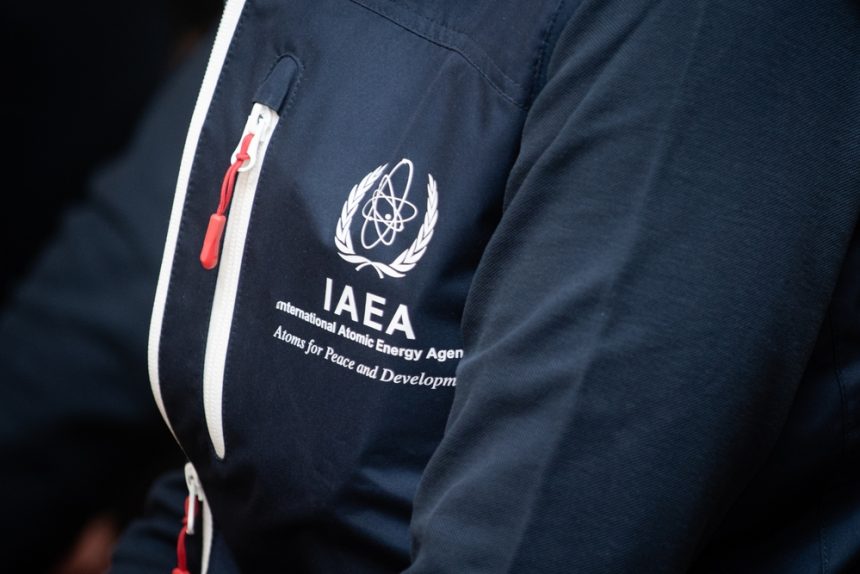
Watchdog prepares conditions for inspections
The International Atomic Energy Agency expects to resume inspections in Iran under the preliminary peace agreement signed by Tehran and Washington, despite conflicting statements about when access will be granted.
“The inspections will indeed take place,” IAEA Director General Rafael Grossi said during a visit to Japan. “We will be working on the modalities – dates, procedures, places – very soon.”
Grossi said the agreement explicitly requires the IAEA to supervise the dilution of Iran’s highly enriched uranium. Iranian officials, however, maintain that access to damaged nuclear facilities and nuclear material must wait until a final settlement is reached.
Preliminary deal leaves room for disagreement
The 14-point memorandum commits the United States and Iran to negotiating a definitive agreement within 60 days. It also establishes that the two countries will determine how Iran’s stockpile of enriched material should be handled.
Under the minimum proposed procedure, the uranium would be diluted at its current location according to a mutually accepted mechanism and under IAEA supervision.
“There’s a war or words here. Some say ‘yes’, the others say ‘no’,” Grossi said. “I can understand political statements. They are part of the reality.”
He nevertheless argued that the document signed by both presidents is unambiguous. “[It] says explicitly that the nuclear activities that are going to be carried out, with regards to nuclear material, facilities, will be supervised by the IAEA, in bold letters. This is going to happen.”
Iran links access to sanctions relief
Iranian Deputy Foreign Minister Kazem Gharibabadi offered a more restrictive interpretation. He said access to bombed nuclear installations and enriched material would be discussed only as part of a final agreement and after practical measures had been taken to remove all sanctions.
“Media noise cannot be used to impose facts on the ground,” Gharibabadi wrote on X.
Grossi said any inspections would be conducted in cooperation with the Iranian government. “Whether this happens the day after tomorrow, or in one week, or in 10 days, it’s important but not essential.”
Washington insists Tehran accepted monitoring
The dispute emerged after US Vice-President JD Vance said Iran had “agreed to invite IAEA inspectors back into their country” during negotiations in Switzerland with Tehran’s chief representative.
An Iranian foreign ministry spokesperson responded that there had been “no detailed discussions”. Tehran also denied planning to give inspectors immediate access to facilities damaged by American strikes during the 12-day conflict between Israel and Iran in June 2025.
President Donald Trump rejected those statements and maintained that Iran had “fully and completely agreed” to inspections.
Rubio consults Gulf allies
US Secretary of State Marco Rubio met UAE President Mohamed bin Zayed Al Nahyan before travelling to Kuwait and Bahrain for consultations about the preliminary agreement.
Speaking in Kuwait City, Rubio said Washington would reject any settlement that weakened the security of its regional allies.
“We’re going to be completely aligned with our partners in the Gulf,” he said.
“If Iran wants to make a good and real deal, the United States is open to that. If they’re not, then of course the president has options,” Rubio added. He said another negotiating round in Switzerland was likely before the end of the month.
Inspectors cannot verify uranium stockpile
IAEA personnel visited Iran’s Bushehr nuclear power station earlier this month. They were still denied entry to the sensitive installations bombed in June 2025.
Without access, the agency cannot determine the present quantity, composition or location of Iran’s enriched uranium. It is also unable to confirm whether enrichment activities have been fully suspended. A significant portion of the material is believed to remain in underground tunnels at Isfahan.
Before the US-Israeli war with Iran began on 28 February, the IAEA estimated that Tehran possessed 440 kilograms, or 970 pounds, of uranium enriched to 60% purity. If further processed to the 90% level associated with weapons, that quantity could theoretically provide enough material for as many as 10 nuclear bombs.
Iran maintains that its nuclear programme is exclusively peaceful and denies any intention to develop or obtain nuclear weapons.
Hormuz reopening pushes oil below $75
The interim agreement also requires Iran to permit shipping through the Strait of Hormuz and the United States to remove its naval blockade of Iranian ports.
Some vessels have already crossed the waterway through an evacuation programme for thousands of sailors stranded during the war. The gradual restoration of maritime traffic helped push Brent crude below $75, equivalent to approximately £57, on Wednesday for the first time since the conflict began.
A decade of unresolved nuclear tensions
Iran agreed in 2015 to restrict its nuclear activities and accept continuous IAEA monitoring in exchange for relief from extensive economic sanctions. The agreement also involved the United States and five other major powers.
Trump withdrew Washington from the accord in 2018 during his first presidential term, arguing that it did not sufficiently prevent Iran from developing a pathway to a nuclear weapon. The United States subsequently restored its sanctions.
Iran responded by progressively exceeding the restrictions established by the agreement, particularly those governing uranium enrichment. The current negotiations are intended to resolve those disputes while establishing new inspection and sanctions arrangements.