Oil surge revives fears of higher interest rates
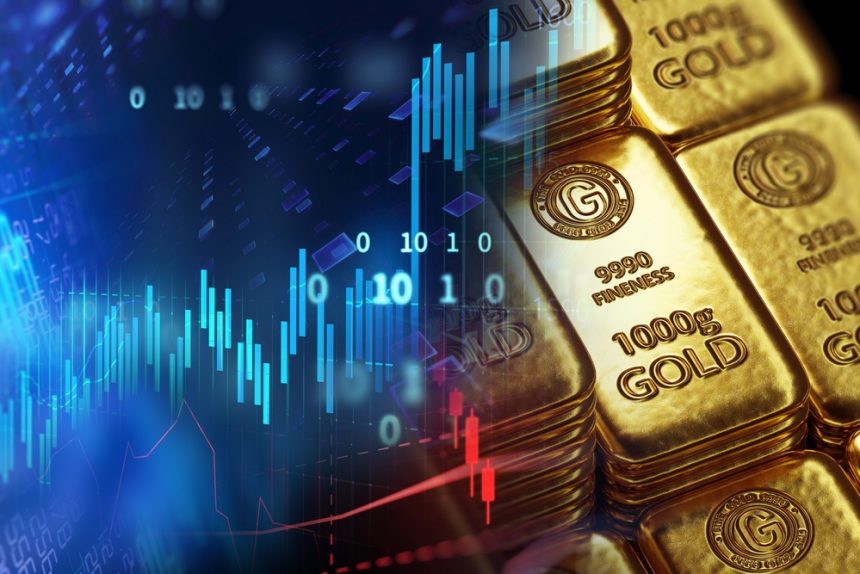
Gold is on track to record its worst weekly performance since early June as rising oil prices linked to the conflict between the United States and Iran strengthen expectations that the Federal Reserve may maintain a more restrictive monetary policy stance.
The impact has been even more severe across mining stocks, which have suffered significant declines as investors reassess the outlook for precious metals and related companies.
Gold moved between gains and losses on Friday, with spot gold rising 0.4% to $3,992.12 per ounce in New York trading. Comex futures returned above the $4,000 level, but the metal remained down around 3% for the week following Thursday’s sharp decline.
Gold retreats after a strong start to the year
June marked gold’s weakest monthly performance since the 2008 financial crisis. The decline from its January peak near $5,600 per ounce represents a drop of roughly 29%, making it only the fifth correction of more than 25% since 1960, according to Morgan Stanley analysts.
Other precious metals also faced pressure. Silver declined 0.4% to $55.74 per ounce, reaching an eight-month low and falling 6.6% during the week. Platinum and palladium also continued their declines, with losses of 20.5% and 22.2% respectively in 2026.
Middle East tensions keep inflation concerns alive
The broader economic environment remains challenging for gold. The United States and Iran entered a sixth consecutive day of clashes, while oil prices increased nearly 13% over five trading sessions.
Although markets currently assign only a 10% probability of a Federal Reserve rate increase at the next meeting, investors are pricing in at least one hike before the end of the year as several Fed officials warn that inflation risks could require tighter policy.
“Softer US CPI and PPI readings recently supported prices by reducing expectations for near-term Federal Reserve tightening,” said Ole Hansen, head of commodity strategy at Saxo Bank. However, he noted that renewed oil gains and additional US strikes against Iran have brought back concerns that higher energy costs could push inflation higher again.
Physical demand offers limited support
Demand from major physical markets has provided little relief for gold prices. Indian dealers offered discounts of up to $45 per ounce during the week, the largest discount in a month, while Chinese premiums declined to almost zero amid weaker demand.
Gold exchange-traded funds also experienced significant outflows, losing $8.9 billion in June. North American investors accounted for $5.5 billion of those withdrawals. Despite the decline, first-half ETF flows remained positive at $8 billion, supported by strong Asian demand, according to World Gold Council data.
Mining stocks suffer heavy losses
The sell-off in precious metals equities has been particularly severe. Several major mining companies recorded notable weekly declines, including Coeur Mining, down 10.8%; Equinox Gold, down 10.5%; Hecla Mining, down 9.9%; Agnico Eagle, down 8.5%; and Fresnillo, down 8.6%.
Gold has fallen 7.2% in 2026, while silver has dropped 21.5%. Among major US-listed companies, only royalty company Franco-Nevada has outperformed gold this year, declining 3.6%.
Newmont has been the strongest performer among large gold producers, down 9.3% year to date. Wheaton Precious Metals has fallen 12.2%.
Major producers face double-digit declines
Losses among other mining companies have been considerably larger. Agnico Eagle is down 18.3% this year, Kinross has declined 19.5%, Pan American Silver has fallen 19.7%, Coeur has dropped 20%, Barrick has lost 20.3%, Hecla has declined 25.7%, Fresnillo has fallen 26.2%, Gold Fields has dropped 26.4%, and Equinox Gold has lost nearly 38%.
Platinum-focused producers have performed even worse. Sibanye-Stillwater has fallen 43.8% in 2026, while Impala Platinum has declined 31.8% and Valterra Platinum has dropped 22.8%.
Mining sector remains far below recent highs
Measured against their 52-week peaks, the losses are even more significant. The average leading US-traded gold and copper mining company is now nearly 38% below its yearly high.
Some companies have experienced deeper corrections, with Hecla down 58% from its peak, Sibanye-Stillwater down 62%, Equinox Gold down 54%, Coeur down 49%, Gold Fields down 48%, and Agnico Eagle down 45%.
The declines followed a difficult second quarter, during which gold lost 14% and the world’s 50 largest mining companies saw approximately $228 billion erased from their combined market value.
Gold remains higher over the longer term
The recent weakness represents a reversal after an exceptional rally. Gold ended 2025 with a 65% annual gain, its strongest performance since 1979, while silver surged 140%.
Despite recent losses, many companies remain significantly higher compared with a year ago. Newmont is still up 55% year over year, Barrick has gained 67%, Coeur has risen 55%, and Hecla remains 140% higher. Silver is also up 47.5% over the same period.
Analysts remain divided on gold outlook
Morgan Stanley expects gold prices to recover from current levels but warned that its outlook depends on the Federal Reserve avoiding additional interest rate increases.
TD Securities analyst Ryan McKay has cautioned that trend-following funds could resume selling if gold falls toward $3,790 per ounce. Such a move could increase pressure on mining companies at a time when investors are also monitoring discussions around the potential revaluation of US gold reserves.